Bullet Journaling: A Beginner’s Guide to Organizing Your Life
December 23, 2025/
Feeling overwhelmed by scattered notes, endless to-do lists, and forgotten goals? Bullet journaling (aka BuJo) might be the game-changer you need. This guide blends the best of both worlds: simple, beginner-friendly tips and deeper insights into the system’s philosophy so you can design a journal that’s practical, creative, and totally yours.
This comprehensive guide blends the best of both worlds: simple, beginner-friendly tips and deeper insights into the system’s philosophy so you can design a journal that’s practical, creative, and totally yours. Whether you’re a productivity junkie, a creative soul, or someone just trying to keep life together, bullet journaling adapts to your unique needs.
What Is Bullet Journaling?
At its core, a bullet journal is like your planner, diary, and to-do list all rolled into one. But unlike store-bought planners, you design every page yourself. This makes it completely flexible whether you’re tracking habits, planning projects, or just keeping your thoughts in order.
Fun fact: The system was created by Ryder Carroll in the early 2010s as a way to manage ADHD, tasks, and life chaos. The idea is simple: rapid logging (short notes, bullet points, and symbols), plus a structure that helps you review, plan, and stay mindful.
The central idea is beautifully simple: rapid logging using short notes, bullet points, and symbols to quickly capture information plus a modular structure that helps you review, plan, and stay mindful about how you spend your time and energy. The BuJo community celebrates both aesthetic spreads and functional, no-frills layouts equally.
The best part? You don’t have to be artistic. You can be sleek and minimalist, or bursting with doodles and washi tape it’s all about what works for you.
Why Bullet Journaling Works
Before diving into the how-to, let’s explore why this analog system remains wildly popular in our digital age:
Reduces Digital Overwhelm: Constant notifications, app switching, and screen fatigue drain mental energy. Writing by hand offers a refreshing break from devices while engaging different cognitive processes.
Enhances Memory Retention: Research shows that writing information by hand improves memory and comprehension compared to typing. The physical act of writing creates stronger neural pathways.
Promotes Mindfulness: Taking time to reflect on tasks, goals, and experiences cultivates awareness about how you’re spending your life. It’s meditation meets productivity.
Completely Customizable: Unlike digital apps with predetermined structures or pre-printed planners with wasted pages, your bullet journal evolves with your changing needs.
No Wasted Pages: Missed a day? Week? Month? No guilt, no wasted pre-printed pages. Just continue where you left off.
Tangible Satisfaction: There’s something deeply satisfying about physically crossing off completed tasks and flipping through pages documenting your progress.
Core Components of a Bullet Journal
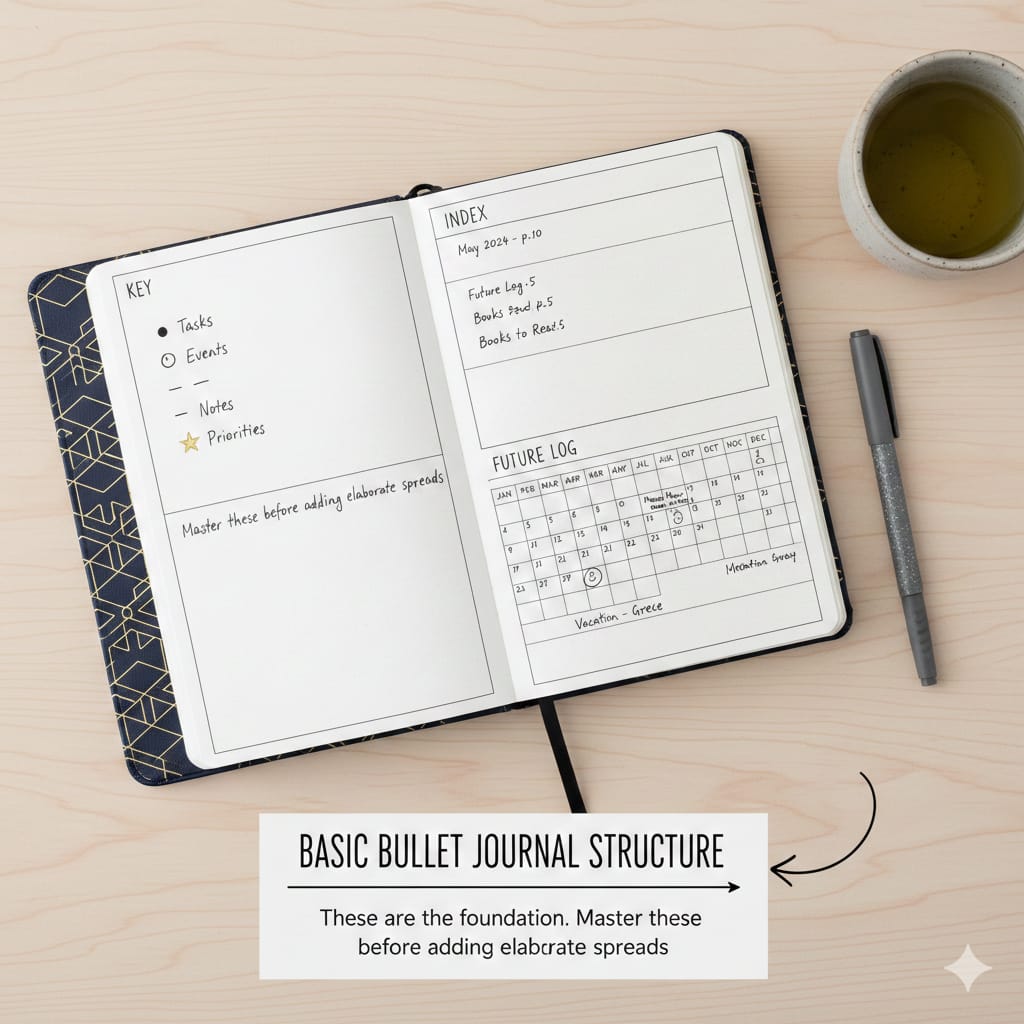
Here’s the basic structure most bullet journals use. These are the foundation master these before adding elaborate spreads:
Key – Your legend of symbols (• for tasks, ○ for events, – for notes, ★ for priorities).
Index – A table of contents so you can actually find things later.
Future Log – A year-at-a-glance section for birthdays, vacations, deadlines.
Monthly Log – A big-picture view of each month plus your goals.
Daily Log – Where most of the magic happens: jotting down tasks, notes, and events.
Start with these essentials. Once you’re comfortable, add “extras” like trackers and goal pages.
1. The Key (Your Legend)
The Key is your personal symbol system for rapid logging. Traditional symbols include:
• Task (something to be done)
○ Event (date-specific occurrences)
– Note (thoughts, ideas, observations)
★ Priority (important tasks)
× Completed task
> Migrated task (moved to future date)
< Scheduled task (added to calendar)
Feel free to customize your Key with symbols that make sense to you hearts for self-care tasks, dollar signs for expenses, exclamation points for urgent items.
2. The Index (Your Table of Contents)
Reserve the first few pages for your Index. As you create new spreads throughout your journal, log them here with page numbers so you can actually find things later. This transforms your journal from a chaotic notebook into an organized reference system.
Pro Tip: Number your pages as you go, or buy a pre-numbered bullet journal to save time.
3. Future Log (Year-at-a-Glance)
The Future Log provides a bird’s-eye view of the entire year ahead. Use it to note birthdays, anniversaries, vacations, project deadlines, and any events beyond the current month. When setting up each new monthly log, reference your Future Log to transfer relevant items.
You can format this as:
Six months per page (simple rows or columns)
Calendar boxes for each month
A simple list format organized by month
4. Monthly Log (Big Picture Planning)
At the start of each month, create a Monthly Log featuring:
Calendar View: A simple list of dates with important events, appointments, and deadlines
Task List: Goals and tasks you want to accomplish this month
Notes Section: Monthly intentions, focus areas, or reflections
This spread helps you see the month as a whole rather than getting lost in daily minutiae.
5. Daily Log (Where the Magic Happens)
The Daily Log is where most of your bullet journaling happens: jotting down tasks, events, notes, and observations as they occur throughout the day. Unlike traditional planners with pre-allocated space, you create each daily entry as needed, using only the space required.
Simply write the date, then rapidly log items using your Key symbols. At day’s end or the next morning, review what’s incomplete and decide whether to migrate tasks forward, schedule them, or delete them if they’re no longer relevant.
Start with these five essentials. Once you’re comfortable with the basic system, you can add “extras” like trackers, collections, and specialized spreads.
Optional Layouts to Try (Without Overwhelm)
Once you’re ready to go beyond the basics, here are some beginner-friendly spreads:
Habit Tracker – Stay consistent with water intake, workouts, or reading.
Mood Tracker – Spot emotional patterns over time.
Gratitude Log – A daily reminder of good things.
Meal Planner – Plan dinners and grocery lists in one place.
Budget Tracker – Stay on top of spending and savings.
Books-to-Read List – Perfect for book lovers (BookTok crowd, I’m looking at you).
Tools You Actually Need (Affiliate-Friendly)
You don’t have to go wild on stationery hauls. Here are the basics:
Dot Grid Notebook: Flexible, neat, and easy to use.
Fine-Liner Pens: Smudge-free writing.
Ruler: For clean lines and structure.
Optional (but fun):
Colored Brush Pens – For headings or accents.
Washi Tape Sets – Quick, pretty decoration.
Stencils & Stickers – Effortless flair.
Organiser Case – Keep pens, tapes, and stencils tidy.
How to Start (Step-by-Step)
Decide Your Purpose – Productivity? Creativity? Mental health?
Set Up the Basics – Index, Key, Future Log, Monthly Log, Daily Log.
Keep It Simple – Don’t overload with spreads.
Stay Consistent – Spend 5–10 minutes daily, or do a weekly review.
Adjust As You Go – If a spread isn’t useful, change it. No guilt.
Benefits of Bullet Journaling
Why bother? Because BuJo isn’t just about pretty pages, it’s about creating a system that serves you.
Organisation Made Simple: No more scattered sticky notes, random notebook pages, and forgotten tasks across multiple apps. Everything lives in one place.
Productivity Boost: The act of writing tasks makes them feel more concrete. Crossing things off triggers dopamine release it feels genuinely addictive in the best way.
Mindfulness & Clarity: Writing things down clears mental clutter, reduces anxiety, and helps you process thoughts and emotions more effectively than typing or thinking alone.
Creative Outlet: Even simple doodles, color coding, or experimenting with layouts provides creative satisfaction. For artistic people, it’s a judgment-free playground.
Personal Growth: Over time, you’ll spot trends in habits, moods, productivity patterns, and goal achievement. This self-awareness drives meaningful improvement.
Reduced Screen Time: Taking breaks from devices benefits sleep, focus, and mental health. Your bullet journal is a tech-free sanctuary.
Achievement Documentation: Flipping through past pages reminds you of how much you’ve accomplished, learned, and grown powerful during discouraging moments.
Common Mistakes Beginners Make (and How to Avoid Them)
Overcomplicating layouts – Start minimal.
Buying too many supplies – Start with the basics.
Comparing your BuJo to Pinterest – It’s not an art competition.
Being inconsistent – Missed a day? Just pick it back up.
Trying too many trackers at once – Build slowly.
Not into paper? You can BuJo digitally using apps like Notion, OneNote, or GoodNotes. Some people even use a hybrid system—paper for reflection, digital for reminders.
I’m often to blogging and i really appreciate your content. The article has actually peaks my interest. I’m going to bookmark your web site and maintain checking for brand spanking new information.






6 Comments
AI TOOLS
AI TOOLS
Miles Palmer
I just like the helpful information you provide in your articles
Jaxon Carpenter
Pretty! This has been a really wonderful post. Many thanks for providing these details.
Hunter Nixon
Awesome! Its genuinely remarkable post, I have got much clear idea regarding from this post
Micheal Suarez
For the reason that the admin of this site is working, no uncertainty very quickly it will be renowned, due to its quality contents.
Martin Padilla
I’m often to blogging and i really appreciate your content. The article has actually peaks my interest. I’m going to bookmark your web site and maintain checking for brand spanking new information.