Tanjore Painting: How This Ancient Art Form Transforms a Home
I grew up watching a Tanjore painting of Lord Ganesha hang in the prayer room of my grandparents’ home. It was gold and green and red, layered and intricate, and it caught the light in a way that made it look alive. As a child, I thought it was just the way certain paintings looked. I did not know it was a 400-year-old art form with its own language, its own ritual, its own process that took weeks to complete.
When I bought my first Tanjore painting for my own home, I understood it differently. It was not just decor. It was an object with weight, history, and intention behind every inch of it. That is a rare thing to be able to hang on a wall.
If you have never heard of Tanjore painting before, or you have seen one and been curious, this is where to start. And if you are somewhere in the world looking for art that brings depth and craft into your home, this is worth knowing about.
What Is a Tanjore Painting
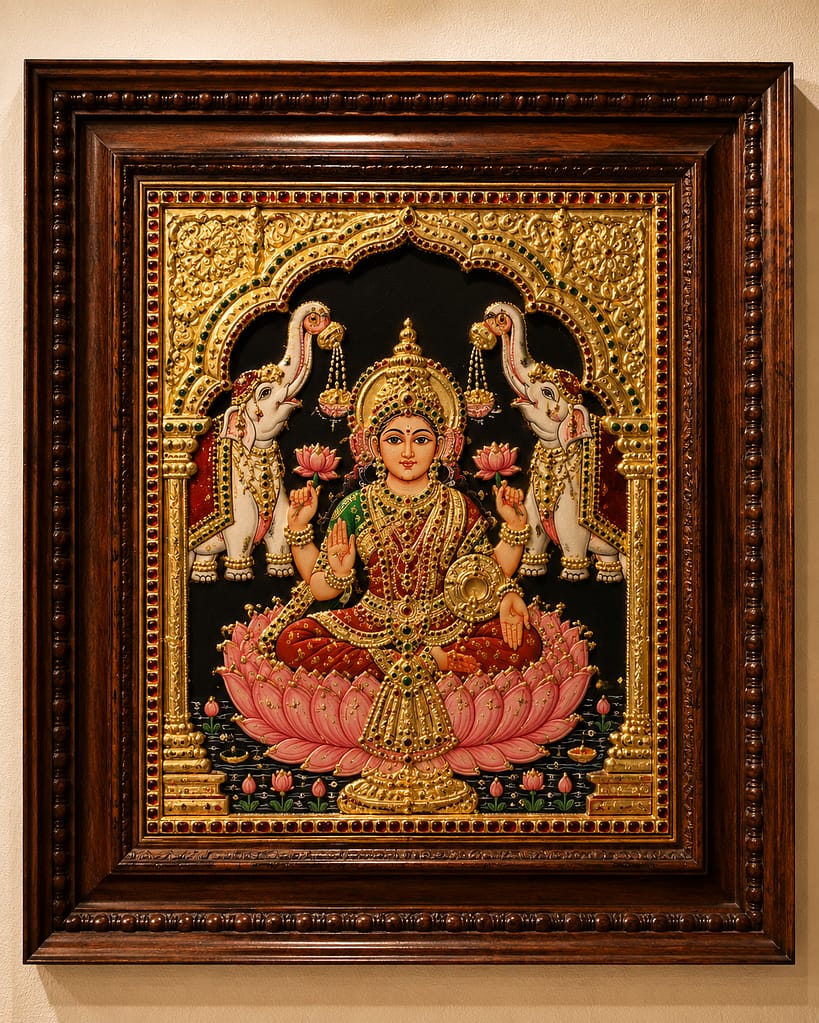
Tanjore painting, also known as Thanjavur painting, is a classical South Indian art form that originated in the 16th century in the town of Thanjavur in Tamil Nadu. It emerged during the reign of the Nayak rulers and later flourished under the Maratha kings, who introduced gold foil work and semi-precious stones, adding grandeur that made this art form unlike anything else in Indian craft history.
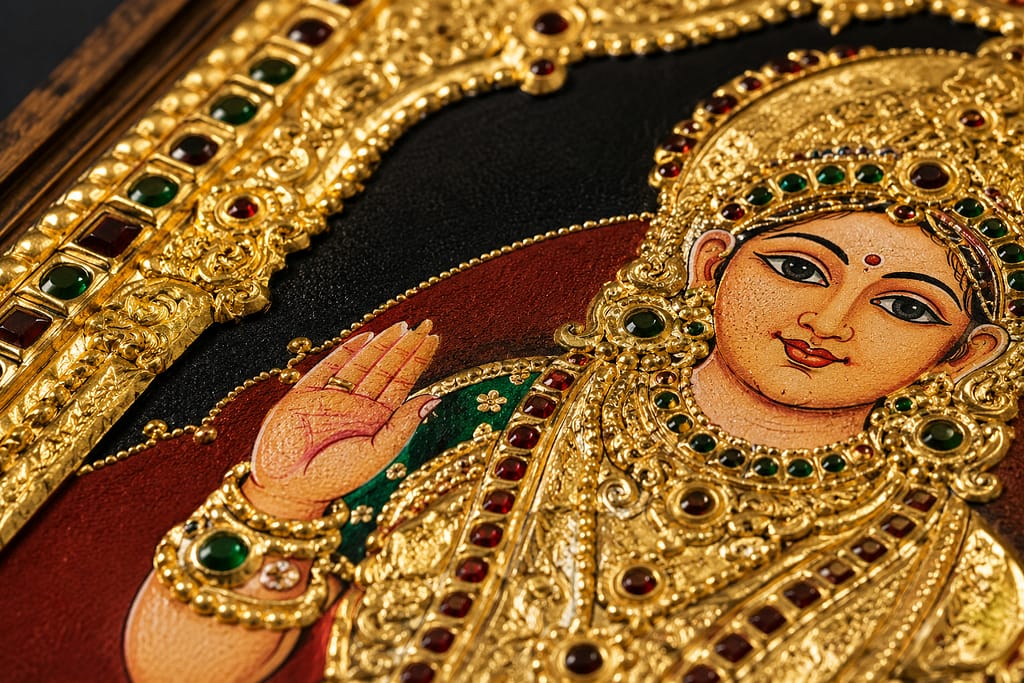
What makes a Tanjore painting immediately recognisable is its gold. Genuine gold foil is applied to create a dazzling effect that symbolises divinity and opulence. The surface involves multiple layers of gesso to build depth and texture, and intricate hand-embossing gives each painting a three-dimensional quality you can feel as much as see.
These are not prints. They are not mass-produced. Creating a Tanjore painting is a meticulous process in which the artist pays close attention to every detail, from sketching the design onto a prepared surface to layering gold leaf over raised areas of the painting to bring that distinguishable golden lustre.
One of the final steps is what gives me pause every time I think about it. The eyes of the deities are drawn last, a step called the “opening of the eyes” in Indian art tradition. The painting is not considered complete until that moment. There is something in that detail that stays with you.
Why Tanjore Painting Is Having a Global Moment Right Now
Here is something I find genuinely interesting. Tanjore painting home decor is shifting from a niche cultural collectable to a mainstream luxury decor choice. Demand is particularly strong right now in North America, Europe, and the Middle East, where boutique hotels, high-end residences, and curated retail spaces are actively seeking authentic, visually striking wall art with a story behind it.
This is not a trend that appeared overnight. People want something that feels both timeless and contemporary, and Tanjore art delivers exactly that. It brings a sense of culture and heritage into modern interiors in a way that no reproduction or mass print ever could.
The broader shift is about how people are now thinking about their homes. There is a genuine tiredness with mass-produced, interchangeable everything. People want objects that have a maker, a history, a reason for existing beyond filling a wall. Buyers internationally are increasingly moving toward hand-painted Tanjore artworks precisely because of the craftsmanship and cultural significance behind each piece.
I think about this the same way I think about investing. A well-chosen piece of art, made with skill and intention, holds its value in a way that a fast-decorating purchase never will. I am a long-term thinker by nature, both in my portfolio and in my home. A Tanjore painting is a long-term purchase. It does not go out of style because it was never in style to begin with. It simply is.
What a Tanjore Painting Actually Does to a Room
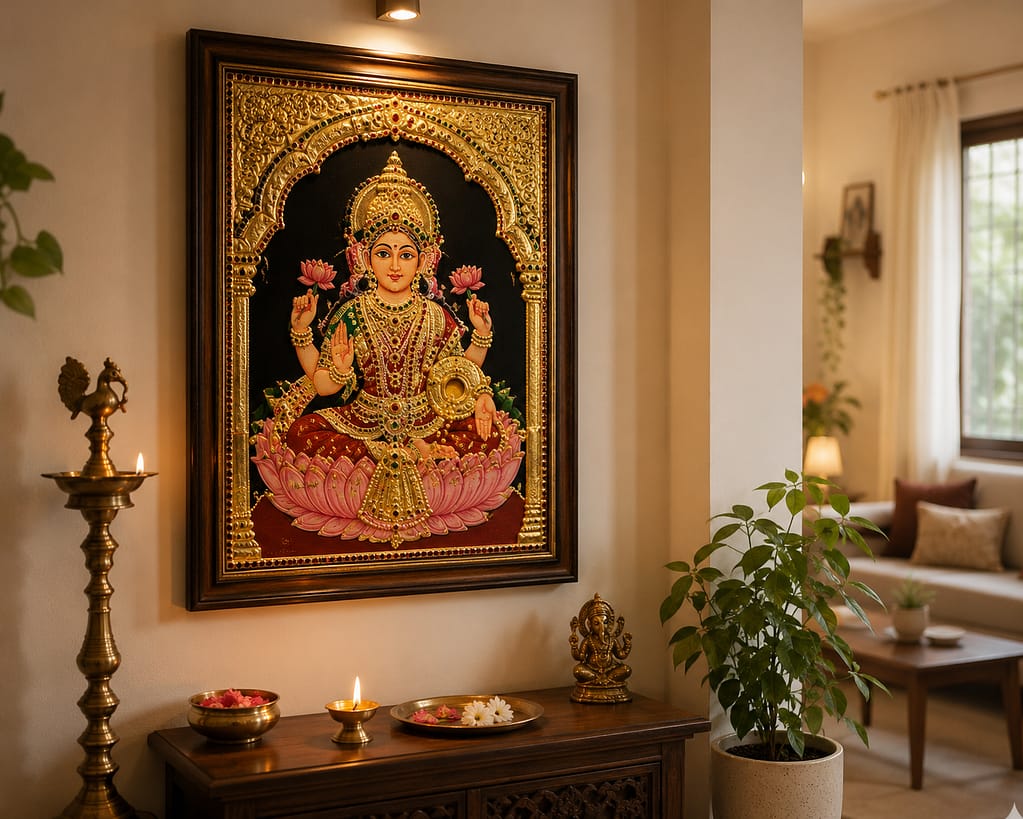
I am going to say something that sounds slightly dramatic but is genuinely true. A Tanjore painting does not just hang on a wall. It anchors a room.
The gold catches light differently at different times of day. In the morning, it is warm and quiet. In the evening, with the room lit, it becomes something else entirely. My daughter noticed this before I pointed it out to her. She walked past the prayer room one evening and stopped.
“Amma, the painting looks like it is glowing.”
She was right. That is what the gold foil does. It is not a static object.
Art lovers and collectors consistently note the positive energy a Tanjore painting brings into a space, creating a calmer, more harmonious atmosphere. Placed thoughtfully, these paintings become more than decorative objects. They become pieces that shift the feeling of an entire room.
For a home that values calm and intentionality, that matters more than most decor decisions. The way a room feels is not just about furniture and colour. It is about what you choose to put on the walls and why you chose it.
How to Choose a Tanjore Painting Without Getting It Wrong
This is where I want to be practical, because the market is genuinely complicated.
China is currently the dominant manufacturing hub for Tanjore-style paintings globally, accounting for over 75 per cent of output. Western buyers often source from Chinese suppliers due to cost efficiency and volume. Which means a large percentage of what is sold internationally as “Tanjore painting” was not made by Indian artisans using traditional techniques.
If authenticity matters to you, and it should if you are buying something for its heritage value, here is what to check before purchasing.
The base material. Traditionally, the base is made from jackfruit or teak wood. Contemporary authentic pieces use waterproof plywood, coated with a mixture of boiled tamarind seed paste and newspaper sheets to create a smooth, sturdy foundation. If a seller cannot tell you what the base is made of, that is your first signal.
The gold. Genuine Tanjore paintings use gold foil, not gold-coloured paint. Some sellers are transparent about using gold dye instead of real foil, which is at least an honest distinction. What you want to avoid is being sold gold paint at gold foil prices.
GI certification. Tanjore paintings have been recognised as a Geographical Indication product by the Government of India. This certification protects the authenticity of the art form and is the clearest official marker of genuine origin. Not every seller will carry this, but it is worth asking about.
The artist. A painting made by a skilled artisan in Thanjavur is a fundamentally different object from a reproduction. The best sellers know exactly who made what they are selling. If a listing cannot tell you anything about the maker, that tells you something,g too.
How to Use a Tanjore Painting in a Modern Home
This is the question I hear most often. The paintings are traditional, often devotional, and the imagery is rooted in Hindu iconography. How does that work in a contemporary home, especially for someone outside that cultural background?
The honest answer is that your options are much wider than they used to be. Contemporary Tanjore artists are now incorporating modern themes, portraits, landscapes, and abstract designs while keeping the traditional techniques intact. The art form has expanded without losing its soul.
But even in its traditional form, a Tanjore painting works beautifully in a modern interior because it does not compete with the room. It simply commands a wall. A growing interior design trend pairs devotional Tanjore paintings with modern art prints, botanical illustrations, and framed calligraphy on a gallery wall. Done with intention, the sacred and the contemporary coexist without any conflict.
In my own home, the Tanjore painting sits alongside simpler, quieter art. The contrast works because one piece does not overwhelm another. The Tanjore brings history and weight. The other pieces bring lightness. Together, the wall feels considered rather than cluttered.
If you are buying one for the first time, start with a single piece and give it a wall to itself. Let it breathe. Let the room adjust to it. You will know within a week whether it belongs there or wants to move.
A Last Thought on Objects That Last
I write a lot about intentional living. About choosing things on purpose, for reasons that hold up over time. Not because something was on sale. Not because it was trending. Because it was worth it.
A Tanjore painting is that kind of object. It was made slowly, by hand, by someone who trained for years to do it well. It will not fall apart. It will not go out of fashion. It holds something of the person who made it and something of the tradition they were taught. That is not something you find in a fast-furniture store or a trending decor drop.
It is the kind of thing you pass on.
The objects in your home tell a story about what you value. A Tanjore painting tells a story that is 400 years old, still being told, and still worth listening to. That is what intentional living looks like when it applies to what you choose to put on your walls.
If this resonated, you might also enjoy Building an Intentional Life: Why Clarity, Quality, and Knowing Yourself Actually Matter, which is the philosophy behind every choice I write about here.
And if you are in the middle of thinking about your home as a whole, [How to Make Your Home Feel Like Summer Without Buying Anything New] is the same principle applied to seasonal refreshing: less noise, more intention, more of what already has meaning.


You May Also Like
Low-Maintenance Indoor Plants That Thrive With Minimal Effort
Home Office Ergonomics: The Complete Guide to Creating Your Perfect Work-From-Home Setup