
The Notion Template That Helped Me Stop Feeling Overwhelmed
I forgot a deadline that week. Not dramatically. Not in the way that made headlines. It just slipped through. I had pitched a client two weeks prior, confirmed the deliverable, noted it somewhere (I thought), and then didn’t think about it again. Until the day it was due, when the email reminder landed, and my stomach did that sinking thing.
I wasn’t disorganised or lazy or scattered. My brain was holding too many things at once: freelance deadlines, two blogs running on different schedules, a seven-year-old’s school calendar, a partner’s work events, and my own projects. Everything was important. Nothing had a clear priority. Everything felt urgent.
This was the overwhelm I’m talking about. Not the dramatic burnout kind. The quiet kind. The feeling of never having finished anything because there was always something else waiting. The Sunday night anxiety that didn’t have a name. The moment you realise you forgot something important.
I knew I needed a system. Not motivation. Not a productivity hack. A system that would help me actually see what I was doing and what I wasn’t.

I was sceptical about the template thing.
I found the Weekly Review and Reset Dashboard template. It looked simple, which made me doubtful. How could something this basic actually help? I had tried planners before. Digital dashboards. Apps with notifications. They always felt like busywork after a few weeks.
I duplicated the template into my Notion workspace anyway. Then it sat there for a week. I opened it once, felt confused about where to start, and closed it.
The second week, I tried again. This time, I actually followed the prompts. Spent ten minutes reflecting on the week that just ended. Answered the simple questions. It felt awkward at first, like journaling for someone else. But I kept going.
By the third week, something shifted. I wasn’t dragging myself to the template anymore. I was looking forward to the Sunday night review. Not because it was fun. Because it gave me clarity.
You can grab the free Weekly Review and Reset Dashboard template here!
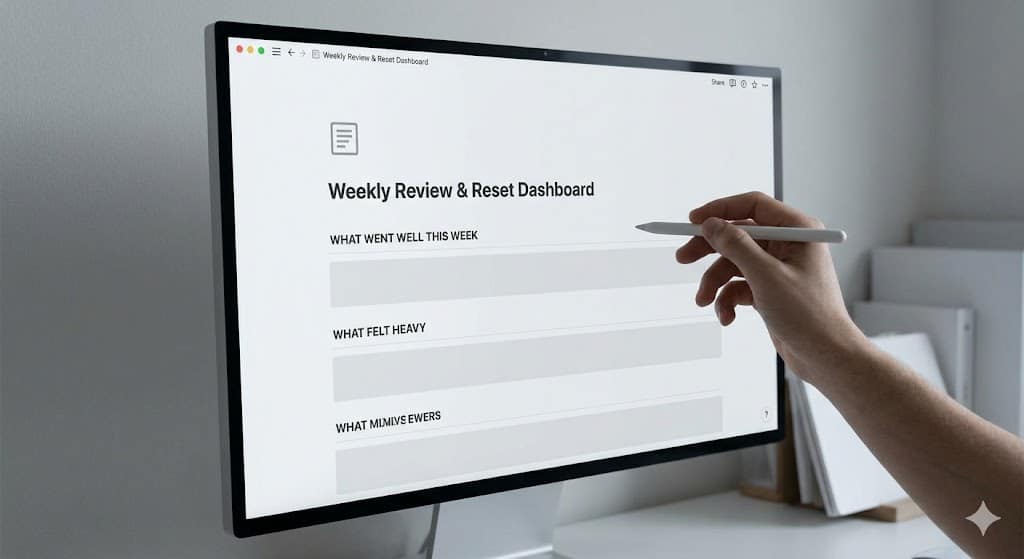
What changed was the structure, not my personality.
The template has this section called “What went well this week.” I had to actually think about it. Not in a gratitude journal way, but in a “what worked and why” way. Finished a project early. Had a peaceful morning. Caught up with a friend. These weren’t earth-shattering wins. They were normal life things. But naming them meant I started noticing them, and noticing them meant I started doing more of them.
Then it asks, “What felt heavy?” This is where the real honesty happens. Too many back-to-back meetings. Neglected self-care. Overcommitting. Again, not dramatic. Just the actual texture of my life that week. Naming what felt heavy wasn’t complaining. It was information. It told me what to protect next week.
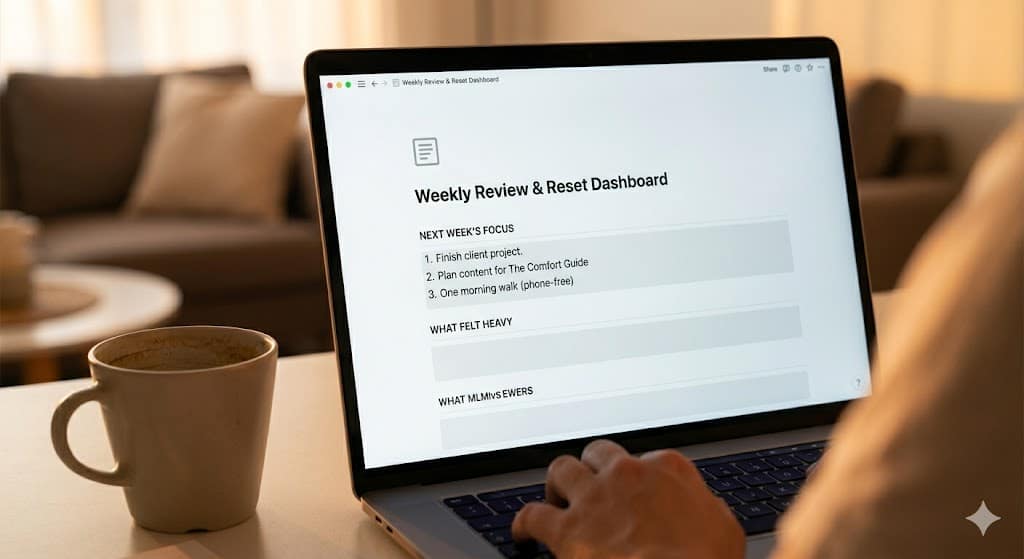
The next section is “Next Week’s Focus.” Three priorities. Not ten. Not “everything.” Three. I write things like “Finish client project,” “Plan content for The Comfort Guide,” “One morning walk without checking my phone.” One of these is work. One is creative. One is personal. That balance alone changed how I approached my week.
There’s also a “Life Areas Check-in.” Work. Home. Health. Money. Personal. It’s quick. Not a deep dive. Just a pulse check. Am I feeling overwhelmed at work, or is my home space cluttered? Is money stressing me,e or am I neglecting my body? Besides, this helped me see patterns. realised that when my home felt chaotic, my work suffered. When I didn’t move my body, my stress went up. These things seem obvious when you say them out loud, but I wasn’t actually tracking them until the template made me.
The “Loose Ends” section is deceptively simple. Small tasks that have been floating in your mind. Email the dentist. Pay the utility bill. Return library books. These aren’t calendar items. They don’t have deadlines. They just live in your head and take up mental space. Capturing them in one place meant they stopped living in my brain and started living in a list where I could actually deal with them.
And then there’s the part I didn’t expect to value: the “Weekly Archive.” Every Sunday, after I do my review, my key reflections get saved. Not for anyone else to read. Just for me. To look back and see patterns over weeks and months. I’ve noticed I’m more creative in the mornings. I need more transition time between work and family time. I make better decisions when I’m not running on fumes.
This is why it became a game-changer.
I was sceptical because I had tried “systems” before and abandoned them. But this template didn’t ask me to be someone I’m not. It didn’t require colour-coding or complex databases, and it didn’t guilt me into productivity. It just asked me to spend ten minutes a week seeing my life clearly.
That’s the thing about overwhelm. It grows in the dark. When you’re not looking at what’s actually happening, your brain fills in the gaps with anxiety. The template forced me to look. And looking meant I could actually do something about it.
Now I use it every Sunday. Not because I’m disciplined in some superhuman way. Because it actually helps. I haven’t forgotten a deadline since I started using it. Not because I have a better memory. Because I’m reviewing my week and setting my next three priorities every single week. That’s it. That’s the magic.
The template is free. It’s built in Notion. Moreover, it takes sixty seconds to set up if you already have Notion, and honestly, even if you don’t, the time to learn Notion and set up the template is worth it. It’s mobile-friendly. It’s beginner-friendly. And it’s designed to be used by one person, living one life, who just wants to stay organised without losing their mind.
Lastly, if you’re someone who feels scattered but doesn’t know where to start, this is where you start. Not with a massive overhaul. Not with an app that promises everything. Just with ten minutes every week to look at your life clearly and decide what matters next.


You May Also Like

The Psychology of a Splurge

Journaling Prompts for Moms Who Need to Think Out Loud