Buying Too Much? Don’t know when to stop?
When you are Buying Too Much, the problem is rarely willpower. I say this as someone who thinks carefully about money, tracks investments across stocks, mutual funds, ETFs, and Sovereign Gold Bonds, and genuinely enjoys the discipline of long-term financial planning. I have also, in the same week, bought something I already owned a version of because the new one looked exciting at the moment, and I was not paying attention.
The gap between how carefully I invest and how casually I sometimes shop is not a contradiction. It is a pattern. And once you notice the pattern, it is much easier to do something about it.
This is not a guilt post. It is not a lecture about minimalism or a budget template. It is an honest look at what overspending actually signals and four questions that work better than willpower ever will.
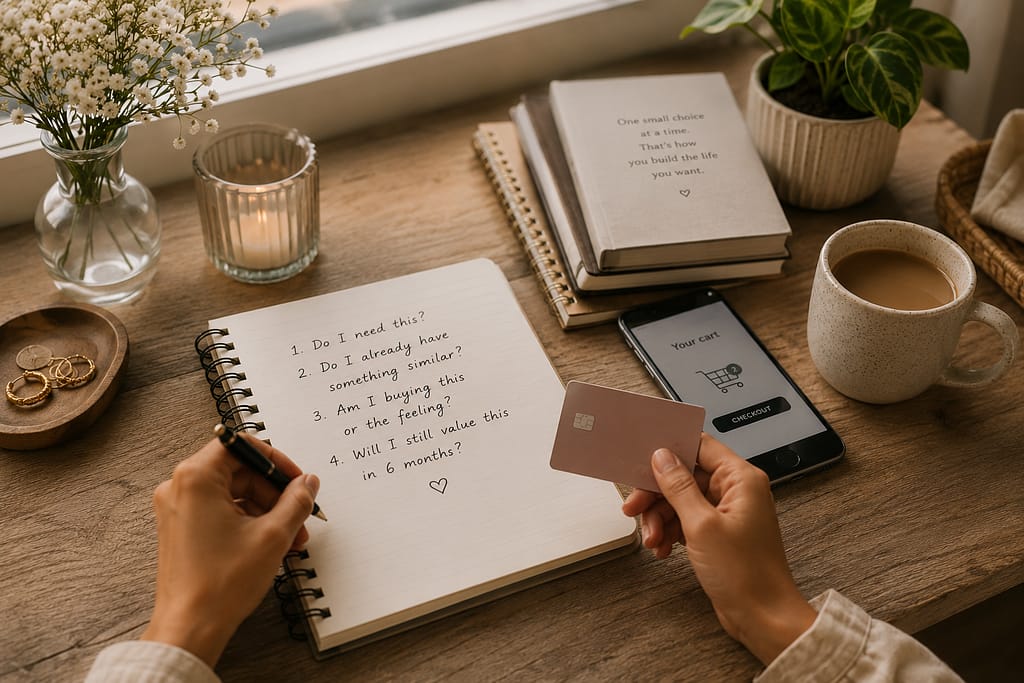
The Signs You Are Buying Too Much Out of Habit, Not Need
This Is Not About How Much You Spend. It Is About Why.
There is a specific feeling that comes with buying out of habit rather than need, and once you know what it feels like, you start recognising it in real time.
You cannot remember why you bought something a week after buying it. Not the specific reason, not what problem it was solving, not even really why it caught your attention. It just arrived.
You buy a version of something you already own because the new one looks better at the moment. Not because the original stopped working. Not because you needed an upgrade. Because the new one was there, and you were in a buying mood.
There is a small high when you click purchase,e and a flat feeling shortly after. Not satisfied. Not the sense of having solved something. Just the absence of the wanting, which is a different thing entirely.
You are shopping to manage a feeling. Boredom that needs filling. Stress that needs an outlet. A bad afternoon that needs a small win. The purchase becomes a way of doing something when you do not know what else to do.
You have things with tags still on. Unworn, unused, untouched. Not because you forgot about them, but because the wanting was satisfied at the point of purchase, and the thing itself was never really the point.
I have been honest with myself about all of these at different times. The glass phase, where I bought beautiful things, I kept breaking. The notebook p,hase where I own more journals than I will fill in two years. The small online purchases added up to a number I did not look at closely enough. Noticing the pattern does not require perfection. It just requires honesty.
Why Your Careful Brain Goes Quiet While Shopping
The Same Person Who Researches an ETF Will Impulse-Buy a Candle
Here is the thing I find genuinely interesting about this. The same mental discipline that makes someone a careful investor does not automatically transfer to everyday spending decisions.
When I research an investment, I do it properly. I think about the long term. I do not panic-buy a stock because of one persuasive article or add something to my portfolio because it looked good on a Tuesday. I take my time. I have a framework.
Shopping for everyday things does not get the same treatment, even though the money comes from the same account. The reason is not laziness or lack of discipline. It is that investing feels like a decision, and shopping often feels like a non-decision, something that just happens in the background of a day.
The fix is not bringing spreadsheet energy to every purchase. That would be exhausting and unnecessary. It is asking one or two pointed questions before you buy, the same way you would pause before adding anything to an investment portfolio. Brief. Practical. Enough to interrupt the automatic.
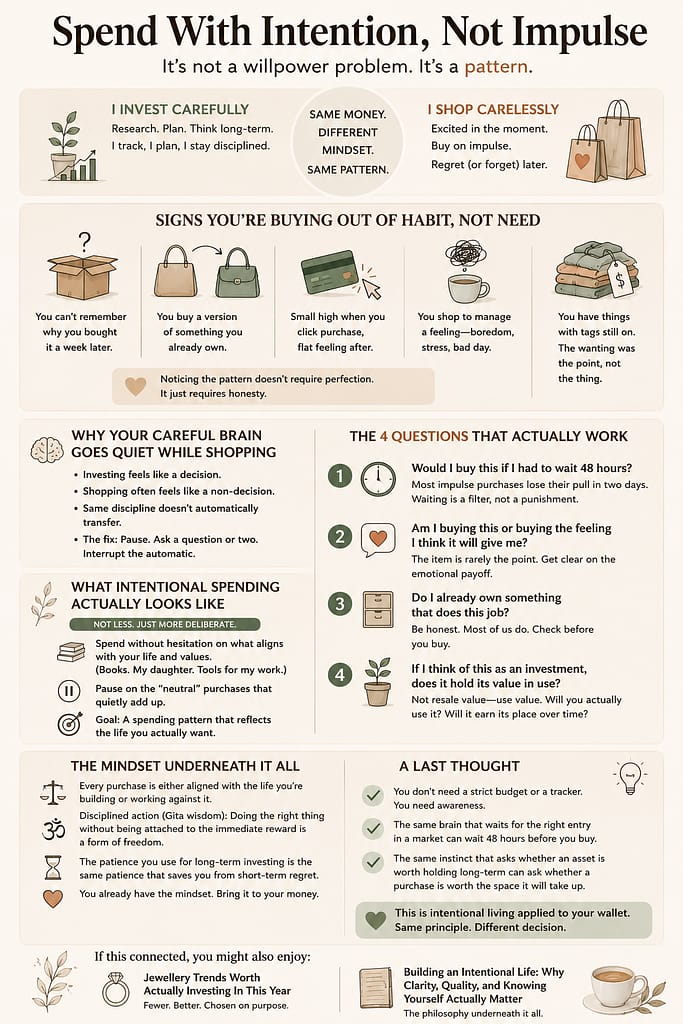
The Four Questions That Actually Work
Simple, Not Preachy
Would I buy this if I had to wait 48 hours?
Most impulse purchases lose almost all of their pull within two days. Not because the item was bad, but because the wanting was time-specific. It needed to be satisfied in the moment, or it passed. Waiting 48 hours is not a punishment. It is a filter that does the work for you.
Am I buying this or buying the feeling I think it will give me?
This is the most useful question and the hardest one to answer honestly. The item is rarely the point. What you are really buying is the version of yourself that owns it, or the feeling of having done something, or the small relief of a decision made. Separating the object from the emotional payoff is where the real clarity lives.
Do I already own something that does this job?
Be honest. Most of us do. The item is usually not filling a genuine gap. It is offering a slightly different version of something that already exists in a drawer or on a shelf. Sometimes the answer ino,o and the purchase makes sense. But asking the question means you have to know the answer before you buy.
If I think of this as an investment, does it hold its value in use?
Not resale value. Use value. Will you actually use it? Will it earn its place in your home or your wardrobe over time? This is where the investor mindset is genuinely useful, not as a way of making shopping feel serious, but as a way of asking whether the thing in front of you is worth what you are exchanging for it.
A good investment holds up. So does a good purchase. A piece of jewellery you wear regularly is a different kind of decision than a trend piece you wear twice. Thinking about the difference before you buy, rather than after, is the whole shift.
What Intentional Spending Actually Looks Like
Not Less. Just More Deliberate.
Intentional spending is not about spending less for the sake of it. It is about choosing on purpose instead of by default.
I spend without hesitation on books, on things for my daughter, on tools that directly support my work. Those categories align with the life I am building, and I know it clearly enough that the decision is easy. What I have learned to pause on is the category of purchases that feel neutral but quietly add up to a number that does not match my priorities.
The goal is a spending pattern that reflects the life you actually want, not a series of disconnected purchases that each felt reasonable in the moment and somehow total to something that does not. This connects directly to long-term thinking, whether that is in a portfolio or in a home. Calm, steady, and chosen. Not reactive, not trend-driven, not solving a feeling that will be back tomorrow.
The Mindset Underneath All of This
Why It Matters Beyond Your Bank Balance
Every purchase is either aligned with the life you are building or quietly working against it. That is not a dramatic statement. It is just true once you start paying attention.
This is not about being wealthy or frugal or having a particular relationship with money. It is about being intentional, which is the same principle that runs through everything I write here. The same clarity that helps you design your days, your home, and your routines also applies to how you spend.
There is something in the Bhagavad Gita that has stayed with me on this. The idea that disciplined action, doing the right thing without being attached to the immediate reward, is not a restriction. It is a form of freedom. Choosing deliberately instead of reacting automatically is freedom. It applies to investing. It applies to shopping. It applies to most things.
The patience that serves a long-term portfolio is the same patience that saves you from buying something you will not remember wanting in a week. You already have that patience. You just have to remember to bring it with you.
A Last Thought
You do not need a strict budget, a spending tracker, or a new system to spend more intentionally. You need awareness, and awareness is something you already practise every time you make a considered investment decision.
The same brain that waits for the right entry point in a market can wait 48 hours before clicking buy on something it does not need. The same instinct that asks whether an asset is worth holding long-term can ask whether a purchase is worth the space it will take up.
This is intentional living applied to your wallet. Same principle. Different decision.
If this connected, you might also enjoy Jewellery Trends Worth Actually Investing In This Year, which is exactly this mindset applied to one specific category: fewer, better, chosen on purpose.
And the philosophy underneath all of it lives in Building an Intentional Life: Why Clarity, Quality, and Knowing Yourself Actually Matter.

You May Also Like

The Best Bags for Every Occasion: Stylish Picks That Balance Comfort and Function
Jewellery Trends Worth Actually Investing In This Year