Kalamkari Sarees and Blouses: Styling Tips
There is something about a kalamkari saree that stops you mid-scroll.
It is not flashy. It does not demand attention the way heavily embellished occasion wear does. But something about those hand-drawn lines, the earthy reds and indigo blues, the stories tucked into the pallu, makes you look twice and then keep looking.
I have been drawn to kalamkari for years, long before “slow fashion” became a talking point. Growing up in South India, these sarees were simply part of the fabric of life, worn to temples, to family gatherings, passed between generations without ceremony. It is only later, when fast fashion started crowding out everything quiet and considered, that I understood what we had always had in these textiles.
If you are new to kalamkari saree styling or want to wear yours more often and in more ways, this guide is for you.
What Is Kalamkari? A Quick Background Worth Knowing
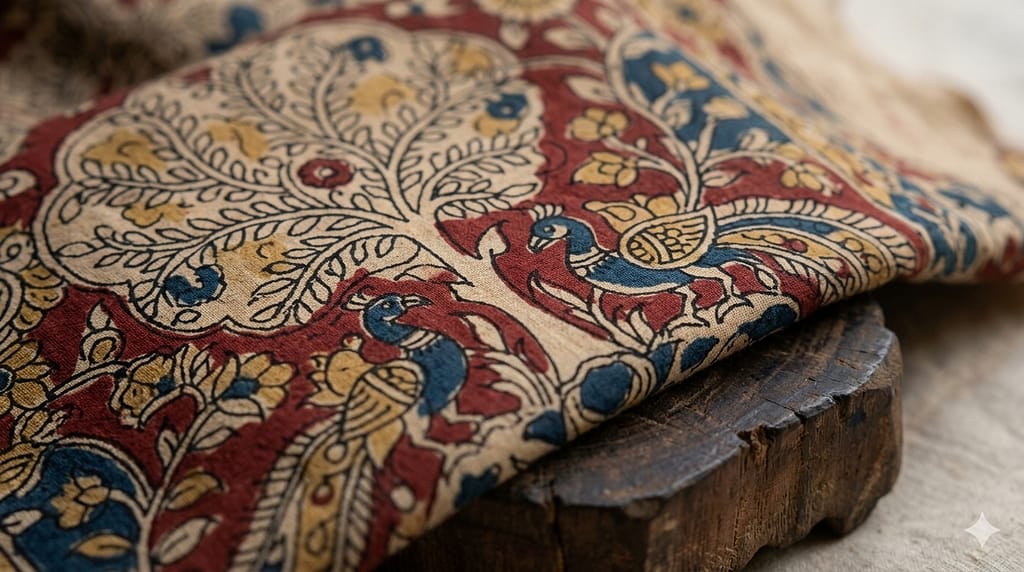
The word kalamkari comes from two Persian words: kalam, meaning pen, and kar, meaning craftsmanship. Quite literally, it is the art of drawing with a pen. Originating in Andhra Pradesh over three thousand years ago, kalamkari began as a devotional art form, temple hangings and narrative scrolls depicting scenes from the Ramayana and Mahabharata. Over centuries, es it has evolved into wearable storytelling, with the same mythological scenes and nature motifs finding their way onto sarees, dupattas, and blouses.
What makes authentic kalamkari distinct is the natural dye process. Madder root gives the deep reds. Indigo creates the blues. Myrobalan produces the yellows. Iron filings fermented with jaggery create the blacks. The process involves over twenty stages, including washing, mordanting, hand-painting, and sun-drying. The result is a colour palette that is earthy, warm, and quietly beautiful in a way that synthetic dyes simply cannot replicate.
Each saree is slightly different from every other. That variation, those small irregularities in line and tone, is not a flaw. It is the signature of a human hand.
Why Kalamkari Fits the Slow Fashion Wardrobe
If you are someone who thinks carefully about what you bring into your home and your wardrobe, kalamkari is a natural fit.
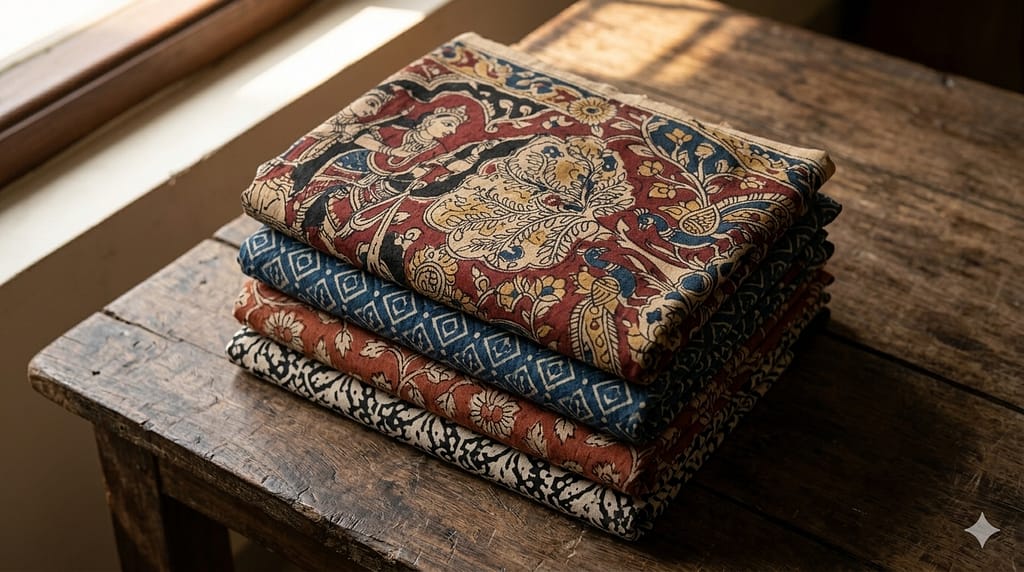
It is made slowly, by hand, using materials that have been part of Indian craft traditions for generations. It is not trend-dependent. A kalamkari saree you buy today will look just as relevant ten years from now because it was never chasing a trend to begin with. Natural dyes actually develop a richer quality over time with proper care, which means the saree you wear on your daughter’s first day of school might look even more beautiful at her graduation.
Many kalamkari sarees become heirlooms this way, not because anyone decided to preserve them deliberately, but because they were simply too good to let go of.
In a wardrobe built around intentional choices, one well-chosen kalamkari saree does more work than five trend-driven synthetic pieces.
How to Style a Kalamkari Saree: Three Approaches
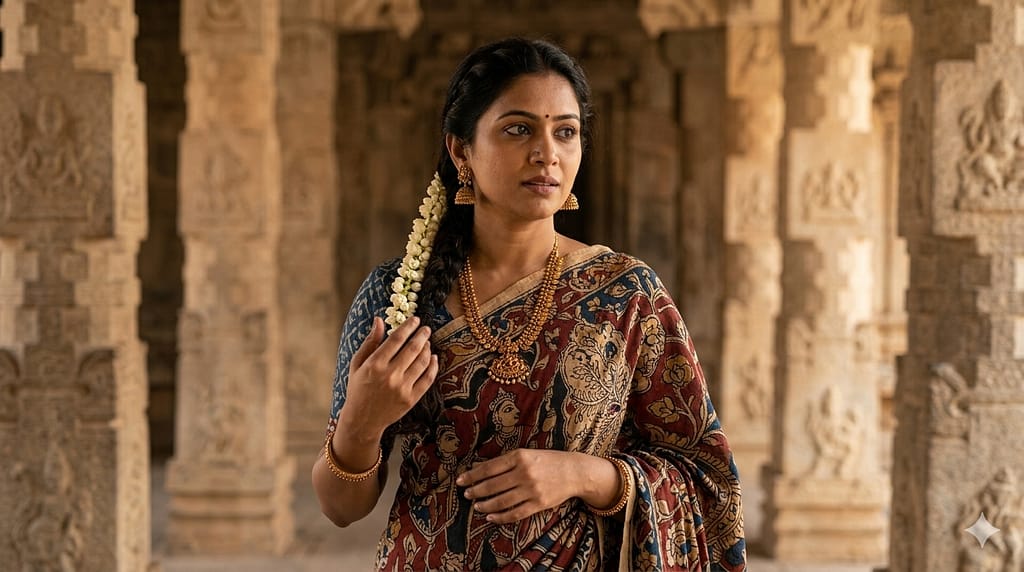
Kalamkari saree styling is genuinely flexible. The same saree can go from a temple visit to a work event to a wedding reception, depending entirely on how you pair it.
The Traditional Look
For weddings, festivals, family functions, or temple visits, lean into everything the saree already is.
Pair it with a heavily embroidered or zari blouse in a colour pulled from the saree itself, deep red, navy, or forest green, depending on your piece. Add temple jewellery: gold or silver jhumkas, a layered necklace, and bangles. If you are in South India, fresh flowers in the hair complete this look in a way that nothing artificial can match.
Keep makeup warm and traditional: kohl-lined eyes, a classic bindi, a muted lip. The idea is that everything supports the saree rather than competing with it. Kalamkari has enough visual story in it already.
The Contemporary Everyday Look
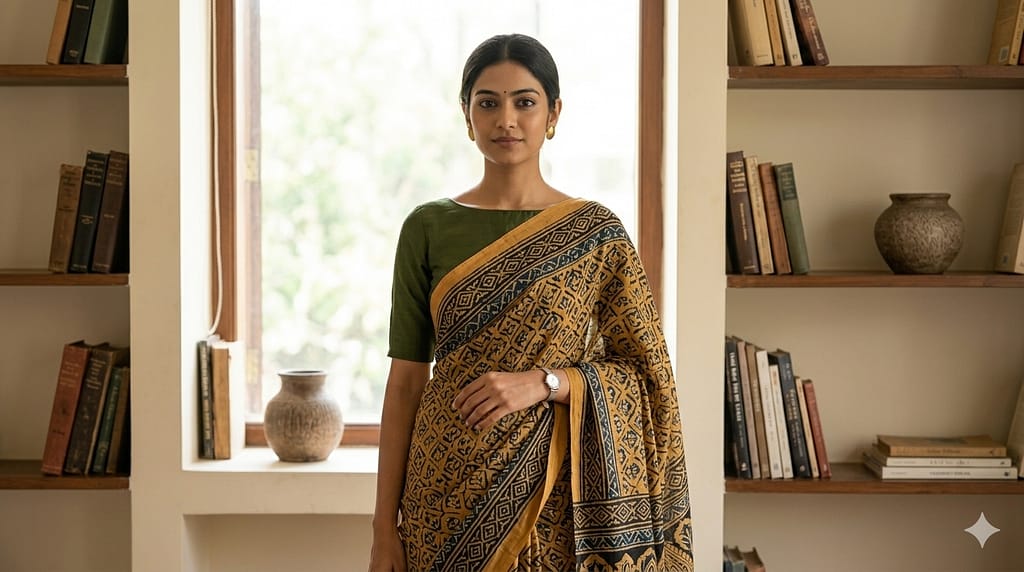
For work, professional events, or modern social occasions, the kalamkari saree is more adaptable than most people realise.
Pair it with a solid blouse in a contrasting or complementary colour: a boat neck, a high neck, or a sleek round neck in raw silk or cotton. Choose minimal jewellery, simple gold studs, a thin chain, or a single statement ring. Keep makeup understated. The saree carries the visual weight. Your job is simply to not compete with it.
Modern draping styles work well here, too. Experiment with the Bengali drape or a pre-stitched style if you want ease of movement during a long day.
The Creative Mix
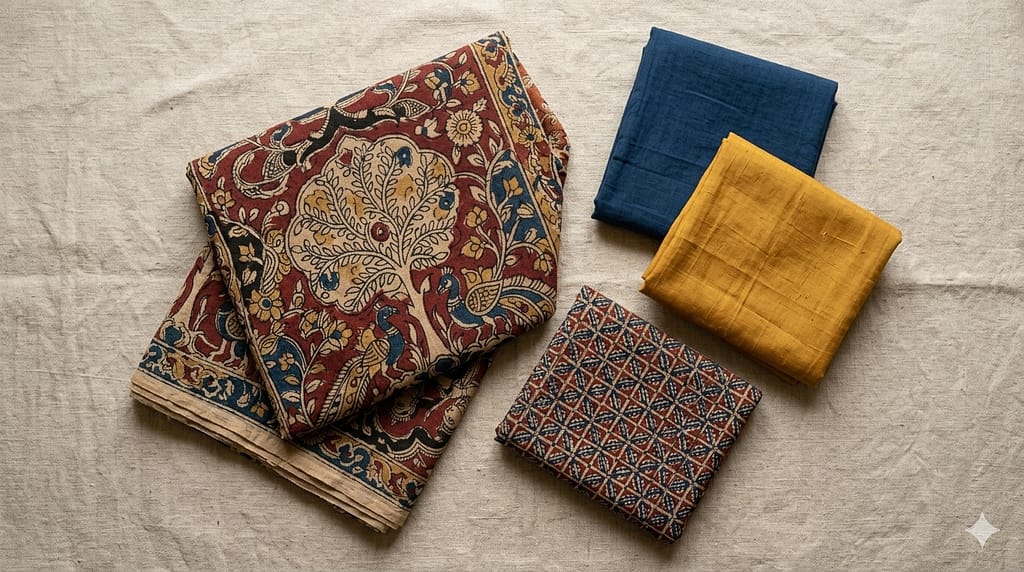
For those who like to push the aesthetic a little, kalamkari rewards experimentation.
Try unexpected blouse fabrics: a raw silk in a colour that does not appear in the saree, a printed cotton that creates a deliberate contrast, or even a structured jacket blouse for a more editorial feel. Play with accessories from other traditions: Rajasthani silver, minimal contemporary gold, tribal jewellery. The kalamkari’s history is already a story of cultural exchange, so it carries mixed influences well.
The one rule worth keeping, regardless of approach: let the saree be the statement. Everything else should support, not compete.
Kalamkari Blouses: What Works and What Does Not
[Image placeholder: Flat lay of kalamkari saree with three blouse options in different styles] Alt text: kalamkari blouse styling option,s Ind,ia traditional, contemporary
The blouse makes or breaks a kalamkari look, so it is worth thinking about carefully.
Solid colours pulled from the saree are the safest and most elegant choice. If your saree has a deep red border, a red blouse grounds the look. If the dominant colour is indigo, a navy or steel blue blouse feels cohesive.
Contrasting colours work when chosen with intention. A mustard blouse with a predominantly black and white kalamkari. A forest green blouse with a rust-toned piece. The contrast should feel deliberate, not accidental.
Kalamkari blouses with plain sarees are a combination worth trying if you have a piece of kalamkari fabric but want something easier to wear. A kalamkari blouse paired with a plain cotton or linen saree in a matching tone is a beautifully understated outfit that works for everyday wear.
What to avoid: Heavily printed or embellished blouses that fight with the kalamkari’s own patterns. The fabric already has a strong visual identity. A busy blouse creates noise rather than harmony.
How to Spot Authentic Kalamkari
As kalamkari has grown in popularity, screen-printed imitations have become widespread. They look similar in photographs but feel and wear very differently.
A few things to look for when buying:
Slight irregularities in the print. Authentic kalamkari is hand-painted or block-printed by hand. Perfect uniformity is actually a sign that it is machine-made.
Natural colour variation. The tones in genuine kalamkari shift subtly across the fabric because natural dyes absorb differently based on fibre variation. Synthetic dyes produce a flat, uniform colour that looks almost plastic by comparison.
The reverse side. Natural dyes penetrate the fabric, so authentic kalamkari has visible colour on both sides. Screen-printed versions are one-sided.
A faint earthy smell. Natural mordants and dyes have a subtle organic scent that disappears after a few washes. Chemical dyes do not.
GI certification tags on pieces from recognised production centres in Andhra Pradesh.
When in doubt, buy from sources you trust: Fabindia, Anokhi, Good Earth, or regional government emporia like Lepakshi in Andhra Pradesh and Poompuhar in Tamil Nadu. Handloom exhibitions like the National Handloom Expo are also reliable sources where you can speak directly with artisans or cooperatives.
Caring for Your Kalamkari Saree
Natural dyes and handwoven cotton require a little more care than synthetic textiles, but nothing complicated.
Hand wash in cold water with a very mild detergent, or use the delicate cycle on your washing machine. Avoid direct sunlight for drying, which can fade natural dyes over time. Store folded with a neem leaf or cedar block rather than mothballs, which can affect the fabric. Press on the reverse side with a medium iron.
Treated well, a kalamkari saree will genuinely last decades.
A Few of My Favourites from Amazon
Kalamkari sarees are increasingly available online, which makes it much easier to find good pieces without waiting for a handloom exhibition.
A few things worth looking for: pure cotton or silk cotton blends, hand-painted or block-printed rather than screen-printed, natural or vegetable dye descriptions in the listing, and seller reviews that mention the quality of fabric and accuracy of colour.
The Saree That Never Goes Out of Style
Fashion moves fast. Kalamkari does not, and that is exactly the point.
There is something deeply satisfying about wearing a piece of fabric that someone made slowly, by hand, using materials drawn from the earth, in a tradition that has survived centuries of change. It does not need to be a special occasion to justify it. Some of the most beautiful outfits are the ones worn on an ordinary Tuesday, just because the saree deserved to be worn.
If you have a kalamkari saree sitting in your cupboard waiting for the right moment, this is a gentle reminder that the right moment is whenever you choose to wear it.
Do you have a favourite way to style kalamkari? Share it in the comments.

You May Also Like
How to Build a Minimalist Capsule Wardrobe Checklist

Elevated Pajamas: The Work From Home Uniform
