How Quiet Moments Made Me a More Intentional Mom
How Quiet Moments With My Daughter Became My Intentional Parenting Practice
I am not the park mom.
My husband is. He loads her into the car, drives to the park, and comes back a hero. She runs, plays with friends, burns through every bit of that seven-year-old energy she carries around like a live wire. And when they leave? That is my quiet time. That is the hour I reclaim for myself without guilt.
When she is home, though, it is just us.
I work from home, which sounds like the ideal setup for a present parent. What it actually means is that I am answering her questions mid-sentence, mid-thought, and sometimes mid-patience. She is curious in that relentless, beautiful way that primary schoolers are. She wants to know everything, immediately, and she wants me specifically to answer it. Some days I do. Some days I tell her to give me ten minutes. Some days, I Google the answer because I genuinely have no idea.
Our time together does not look like the activities I see other moms talk about. No elaborate crafts. No sensory bins. No scheduled enrichment.
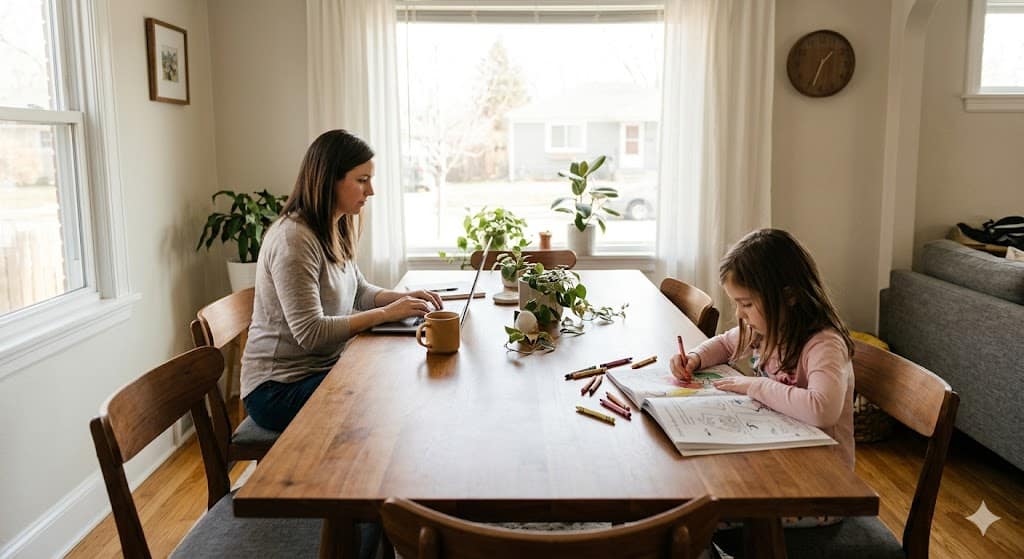
It looks like colouring in the same room, both of us in our own world. It looks like cooking together, cleaning together, and watering plants. It looks like sitting on the couch watching a film I actually want to watch, with her next to me, asking questions the whole way through.
These were things I already did alone. I just started including her.
The Rule That Changed Everything
For a long time, I tried to do what she wanted. Full effort, activities pulled from the internet, things I had no interest in. She would lose interest halfway through, and I would be sitting there with half a Play-Doh project and a low-grade resentment I did not know what to do with.
So we made a quiet agreement, nothing formal, just a shift in how we approached time together. One thing she likes. One thing I like. That is it.
What came from my side was reading, music that is not made for children but is age-appropriate, drawing, and the plants. What came from her side was her curiosity, her company, and her willingness to follow me into things she had never tried.
It sounds simple. It works because it is honest. Neither of us is performing or faking the enjoyment we do not feel.
Her Seventh Year Changed the Conversations
Until recently, she was blissfully unaware of how other people behaved around her. She played by herself when she wanted to. She joined other kids when she felt like it. If someone was unkind, she simply did not register it. There was something quietly wonderful about that obliviousness.
This year, that changed.
She started noticing. She came home and told me her friend said something mean,n and she felt angry. She started connecting what happened to how it made her feel. That is not a small thing for a seven-year-old. That is emotional awareness arriving, and it arrived fast.
What I realised quickly is that she had the feeling but not always the word for it. She knew something was sitting wrong inside her, er but she could not name it. And here is what I have learned: naming something gives it an address. When you tell a child, “That sounds like you felt left out,” or ” It makes sense that you are angry, that was not kind,” something in them settles. It does not fix the situation. It just makes the feeling less strange and less frightening.
This is not a gentle parenting philosophy. This is just practical. A child who can name what she feels is easier to talk to, easier to support, and eventually, easier to send back out into a world that will not always be kind to her.
I cannot change what her friends do. I can prepare her to handle it, feel it fully, and not be undone by it.
The Habit That Started by Accident
The most consistent thing we do together now is read. Not fairy tales, not chapter books, but stories about real people and real things.
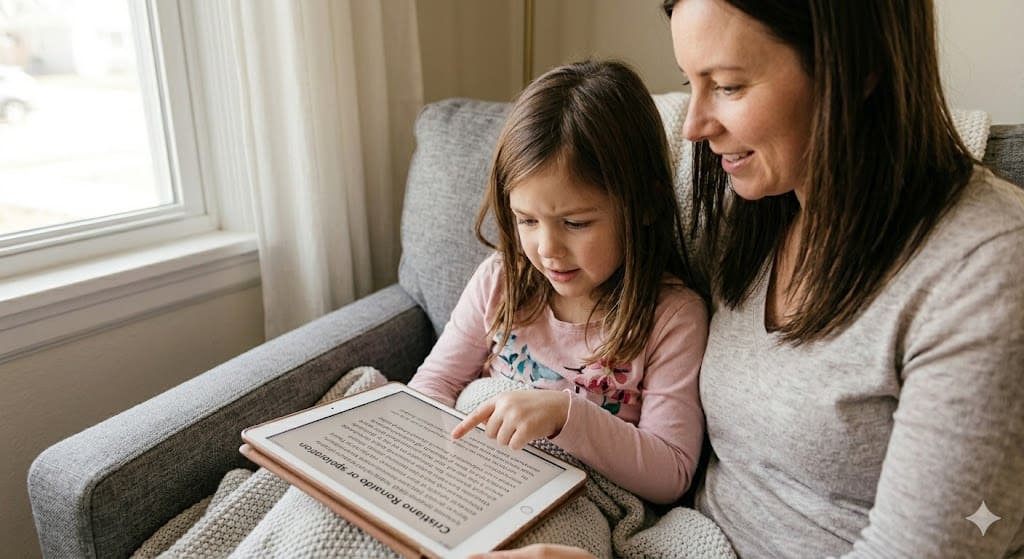
I found an app that tells stories in short, self-contained pieces. Not chapter one and chapter two. Just a moment from someone’s life, told well, at the right level for her. We have read about Cristiano Ronaldo. Neil Armstrong. How plastic moves through the world. How paper is made and remade. Each story takes about five minutes to read aloud. Then comes the question, another five minutes, sometimes more. Then we talk about it, the wow of it, what she thinks, what I think.
When I do not know the answer, I say so. We open Google together.
The day we read about Neil Armstrong, we ended up watching the Apollo 11 documentary that evening, all three of us. She watched the rocket lift off, and her face did the thing that children’s faces do when something is genuinely astonishing. We became children alongside her that night.
This habit takes about fifteen minutes on a school day. Sometimes less. It has become the thing we do every day without having to decide to do it. It just happens.
And it spills over. We have conversations now when we are out, waiting in a queue, or sitting in the car. She brings up things we read. I bring up things she wondered about. Her father gets pulled into discussions he did not see coming. A fifteen-minute reading habit became a thread that runs through the whole family.
What Intentional Parenting Actually Looks Like
I want to say this clearly because I think it gets lost in the noise around parenting content.
Intentional parenting is not a curriculum. It is not a colour-coded schedule or a set of Pinterest activities or a morning routine someone designed for maximum development outcomes. It is showing up in the ordinary moments you were already living and choosing to be present in them.
Watering your plants? Bring her. Tell her what you know. Look up what you do not. Let her carry the small pot.
Reading something you find interesting? Read it out loud. Let her ask questions you cannot always answer.
Cooking dinner? Hand her something to stir.
The effort is not in designing the activity. The effort is in not doing it alone when you do not have to.
I also want to say this: you have to enjoy it too. That is not selfish; that is the whole point. If you are enduring an activity for her sake while counting the minutes, she feels that. Children always feel that. The moments that stick, for both of you, are the ones where you were genuinely there.
She may not remember the specific stories we read or the exact plants we watered. But she will remember how it felt to be beside me. That is what stays.
One Last Thing
Some days the story does not happen. Some days I am at my desk until 7pm, and she is watching something on the table,t and we eat dinner and fall into our own tiredness. That is also real life.
Intentional parenting is not a perfect streak. It is a return. You come back to it. You sit beside her again the next day and read one story about a rocket scientist and watch her eyes go wide.
That is the long game. Quiet, ordinary, and completely worth it.
If you want to start building more intentional moments with your child, the parent-child journal I created is a good place to begin. Simple prompts. No pressure. Just a place to pay attention together.
And if this resonated, you might also want to read: Building an Intentional Life: Why Clarity, Quality, and Knowing Yourself Actually Matter


You May Also Like

Bonding Activities for Moms and Daughters at Home

A Mother-Daughter Journal