
Intentional Living Starts Before Your First Coffee
What is the first thing we do as soon as we wake up?
The first thing most of us reach for in the morning is our phone.
Not because we mean to. Not because we have consciously decided that the best use of the first minutes of our day is scrolling through notifications that accumulated while we slept. It is just the automatic motion that the morning has trained itself into. Alarm goes off, hand reaches sideways, screen lights up, and before we are fully awake, we are already reactive. Already responding to the world’s agenda rather than our own.
I know this pattern well because I lived it for years. The morning scroll that started as a quick check and became twenty minutes. The low-level anxiety that arrived before I had even gotten out of bed, carried in by whatever the notifications had delivered. The day started on someone else’s terms before I had established any of my own.
What changed it for me was not a dramatic overhaul or a 5am wake-up or a forty-five-minute meditation practice. It was something considerably simpler: I started protecting the first part of my morning from everything that wanted a piece of it, and using that time to arrive at the day on my own terms instead.

The First Hour Shapes Your Whole Day
There is genuine research behind the idea that the early hours of the day carry disproportionate influence over how the rest of it unfolds. Our brains in the period just after waking are in a more receptive, less defended state. The habits and inputs we introduce in that window tend to set an emotional and cognitive tone that persists.
The practical implication is straightforward: what you do first thing matters more than what you do at 2pm. Not because of magic or wellness industry mythology, but because of how mood, attention, and cortisol levels actually work in the morning hours. Starting with calm tends to produce a calmer day. Starting with reactive scrolling tends to produce a more reactive one.
This is not about achieving a perfect morning. It is about being deliberate with a window of time that most people hand over without thinking about it.
✅ Skip notifications
✅ Stretch instead of scroll
✅ Say one thing you’re grateful for
Beyond the Instagram-Perfect Morning Routine
Social media has done something unfortunate to the concept of a morning routine. It has turned a personal and private practice into a performance, complete with aesthetic requirements.
The staged meditation corner. The colour-coordinated breakfast spread. The woman wakes up appearing to have already had a full night’s sleep, plus professional hair and makeup. These images are not mornings. They are content. And the gap between that content and the actual experience of being a real person waking up in a real home can make the whole idea of a mindful morning feel inaccessible before you have even tried it.
A genuine morning practice has nothing to do with how it looks. It has to do with how it feels. Whether you leave that first quiet hour feeling more like yourself than you did when you woke up. Whether you arrive at the demands of your day with some degree of groundedness rather than already feeling behind.
My morning does not look like anyone’s Instagram. I wake up, I do not look at my phone, I make tea, and I sit somewhere quiet for a while. Sometimes I journal. Sometimes I just sit. It is not visually compelling. It is genuinely useful.
What an Intentional Morning Actually Looks Like
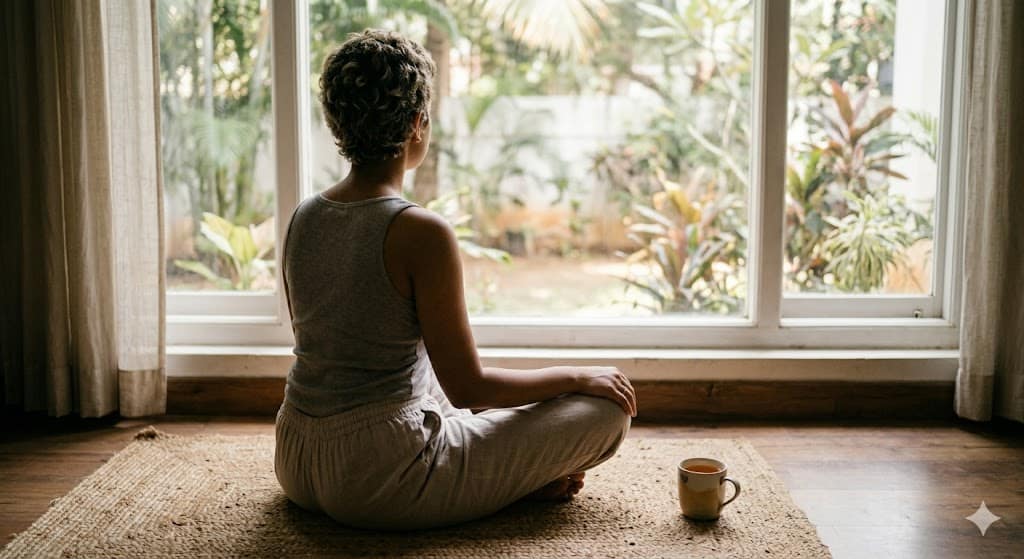
The elements that consistently make a morning feel grounded rather than chaotic are simpler than most morning routine content suggests.
No phone for the first thirty minutes. This is the single change with the highest return. Thirty minutes is not a long time. It is long enough to wake up properly, make a drink, and begin the day without immediately importing other people’s urgency into your nervous system. If thirty minutes feels impossible, start with ten. The point is to create any gap at all between waking and reacting.
Something quiet. A few minutes of breathing, sitting without an agenda, or gentle stretching. Not because these things are inherently transformative on their own, but because they create a moment of deliberate stillness before the day accelerates. The morning is the one time of day when you have genuine permission to be slow, and most people spend it rushing anyway.
Some form of reflection. Journaling is the practice I keep returning to because it works consistently for me. Not elaborate journaling with prompts and structure, though that has its place too, just a few minutes of writing down whatever is present. What I am thinking about, what I want from the day, what I am grateful for in the most ordinary sense. It functions as a clearing mechanism, and I notice the difference on days I do it versus days I skip it.
Mindful engagement with your first drink. This sounds small, and it is small. But sitting with your first cup of tea or coffee without a screen in front of you, just the drink and a few minutes of quiet, is a form of presence that accumulates into something meaningful when it becomes daily. It is also, practically speaking, more enjoyable. The tea actually tastes better when you are paying attention to it.
One intention for the day. Not a to-do list, not a schedule review, just one thing you want to feel or do or bring to the day. It takes thirty seconds,s and it functions as an anchor when the day gets complicated, which it usually does.
Why This Is the Heart of Intentional Living
Intentional living is a phrase that gets used a lot and is defined vaguely. What it actually means in practice is making conscious choices about how you spend your time and attention rather than defaulting to whatever is most convenient or most immediately available.
The morning is where intentional living either starts or does not. Because the morning is the moment before the day has made its demands, before the emails have arrived, and the responsibilities have activated, and the noise has begun. It is the only part of the day that genuinely belongs to you before anyone else has claimed a portion of it.
Using that time to arrive at yourself rather than immediately at the world is not productivity advice. It is something quieter and more fundamental than that. It is the difference between a day that you move through consciously and a day that simply happens to you.
Starting Smaller Than You Think You Need To

The mistake most people make when building a morning practice is starting with too much. A full meditation, journaling, exercise, reading, and a nutritious breakfast, all before 7am. This works for approximately four days before life interrupts and the whole structure collapses under its own ambition.
Start with one thing. One change that is so small it cannot reasonably be argued with. No phone for the first ten minutes. One page of journaling. Five minutes sitting quietly with your tea before you open your laptop.
Do that one thing until it feels natural. Until you notice what it adds to your day. Then, only then, consider whether you want to add something else.
The goal is not an impressive morning routine. The goal is a morning that leaves you feeling more settled and more yourself than the one you had before. That is achievable with very little. It just requires doing the little things consistently rather than the impressive things occasionally.
The Honest Version
My mornings are not early. I wake up around 9am, I keep the first hour loose, and I do not start work until 10. That hour is mine. Not productively mine, not optimised mine. Just mine.
I make tea. I sit. Sometimes I journal for twenty minutes, sometimes for five. I do not look at my phone until I am ready to, which is usually after the tea and after whatever quiet I needed that morning. Some days, that looks like a slow, calm hour. Some days it looks like fifteen minutes before something interrupts it.
It is not perfect. It does not need to be. It just needs to be intentional enough that I feel like I chose how the day started rather than the day choosing for me.
That, in the end, is all intentional living really requires. Not a system. Just a decision, made fresh each morning, to begin on your own terms.
🎁Bonus: Download My Morning Ritual Printable
Want a pretty version of this? I made you one:


You May Also Like
Building an Intentional Life: Clarity & Quality Matter
Bullet Journaling: A Beginner’s Guide to Organizing Your Life