Simple Daily Habits for a Healthier Lifestyle: Your Complete Guide to Wellness
I have never been someone who approaches health with dramatic intensity. No juice cleanses, no 5am boot camps, no thirty-day challenges that collapse on day nine. That kind of all-or-nothing energy has never suited my temperament and, honestly, I have never trusted it. Anything that requires you to completely overhaul your life to work is already building its own failure into the plan. Let’s build Simple Daily Habits for a Healthier Lifestyle.
What I have found works, actually, for me and from what I observe in most people who manage to sustain healthy habits long term, is considerably less dramatic. Small things, done consistently, that gradually become so woven into your daily rhythm that they stop feeling like habits at all and just become how you live.
I work from home, I have a young daughter, and I keep a schedule that is structured but not rigid. My approach to health has to fit around that reality, not ask me to sacrifice it. What follows are the habits I have genuinely built into my days, why they work, and the practical details of how to actually start them without requiring a personality transplant.
Why Small Habits Lead to Big Changes
The reason most health overhauls fail is not lack of motivation. It is architecture. When you try to change everything at once, you are relying entirely on willpower, which is a finite resource that runs out by Wednesday of the first week.
Small habits work differently. They ask so little of you initially that resistance barely forms. A ten-minute walk is not something your brain needs to negotiate with. A glass of water before your morning coffee is not a sacrifice. But these small actions, repeated daily, compound in a way that feels almost unreasonable after six months.
The research on habit formation suggests it takes anywhere from three weeks to two months for a new behaviour to become automatic, depending on the complexity of the habit and the person doing it. The practical implication is simple: start smaller than you think you need to, stay consistent longer than feels necessary, and trust the compounding effect to do the work that motivation cannot sustain alone.
Incorporate More Movement into Your Day
The relationship most people have with exercise is unnecessarily adversarial. It has been framed for so long as something you force yourself to do, in a specific place, at a specific time, in specific clothes, that the friction involved in starting feels insurmountable on any day that is not already going perfectly.
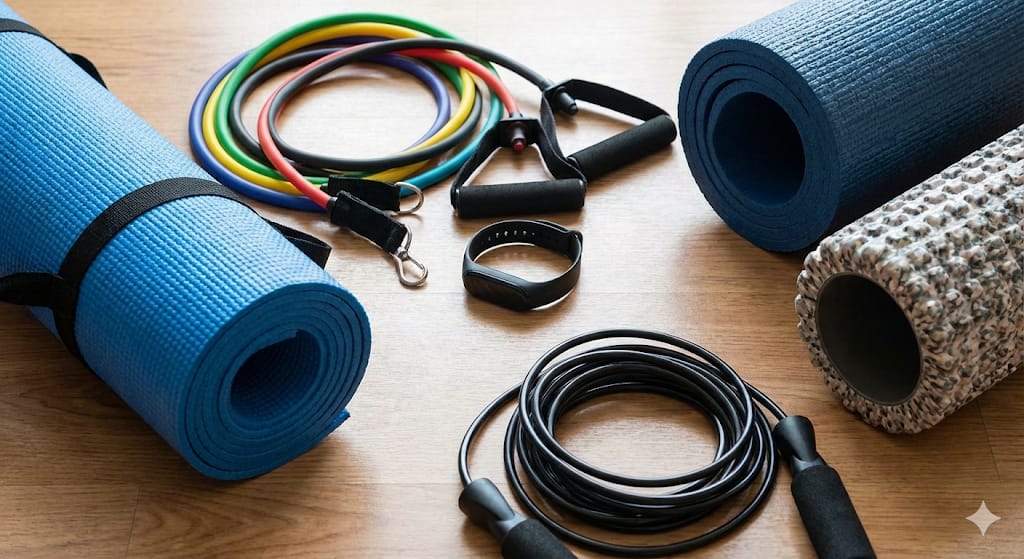
I do not have a gym membership. I do not do structured workouts every day. What I do is move consistently and look for ways to add movement to the day I am already having, rather than carving out a separate workout-shaped slot in my schedule.
On good days, this looks like a proper walk, thirty to forty minutes in the morning before my daughter leaves for school, which also happens to be one of the most effective things I have done for my mental clarity through a working day. On an average day,s it looks like desk stretches every hour, a quick ten-minute stretch session before I sit down to work, and making myself get up between tasks rather than staying anchored to my chair.
The habit that made the biggest difference was the simplest one: I stopped sitting still for more than an hour at a stretch. Setting a gentle reminder and getting up, even for five minutes, breaks the physical stagnation that makes long working days feel so draining.
The best movement habit is the one you will actually repeat tomorrow. Start there.
Hydration Section
This is the habit that made me feel quietly foolish when I finally paid attention to it, because the improvement was so disproportionate to the effort required.
I was chronically under-hydrated for years without realising it. Not dramatically so, I was not collapsing from thirst, but consistently operating at a mild deficit that showed up as afternoon fatigue, occasional headaches, and a general flatness by 3pm that I had attributed to other things entirely. When I started drinking water more consistently and earlier in the day, the difference was noticeable within a week.
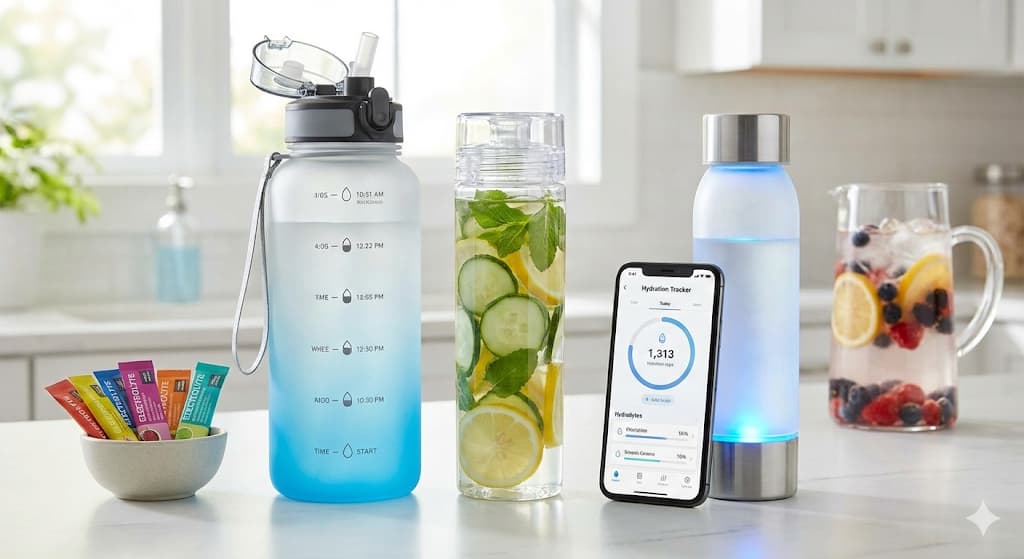
The habit that worked for me was structural rather than motivational. I keep a large water bottle on my desk where I can see it. I drink a glass first thing in the morning before anything else, including coffee. I refill the bottle twice before my working day ends. That is it. No tracking app, no complicated formula, just visible water within reach and a few fixed moments in the day where drinking it is the obvious next thing to do.
The general guidance of around two litres a day is a reasonable starting point, adjusted upward if you are in a warm climate, exercising, or going through a particularly demanding stretch. Signs of mild dehydration, fatigue, difficulty concentrating, and headaches are easy to dismiss as other things. When in doubt, drink water first and see what changes.
If plain water feels like a commitment you will not sustain, infusing it helps considerably. Cucumber and mint, lemon and ginger, berries and citrus. The water tastes like something; the more you drink of it, the habit holds.
Fuel Your Body with Nutritious Foods
I want to say something about nutrition that most wellness guides skip over: eating well is significantly easier when you stop treating it as a performance.
The diet culture framework, the tracking, the macros, the meal plans that require Sunday afternoon as a sacrifice, work for some people and create an exhausting relationship with food for many others. I am firmly in the second group. The more I tried to be precise about what I ate, the more mental energy it consumed and the less sustainable it became.
What replaced it was considerably simpler: a set of loose principles that guide most decisions without requiring calculation. More vegetables than I think I need. Protein at every meal because it genuinely affects how full and focused I feel. Whole grains rather than refined ones, where the choice is available. I’m lessening my ultra-processed food not because of ideology, but because it consistently makes me feel worse a few hours later.
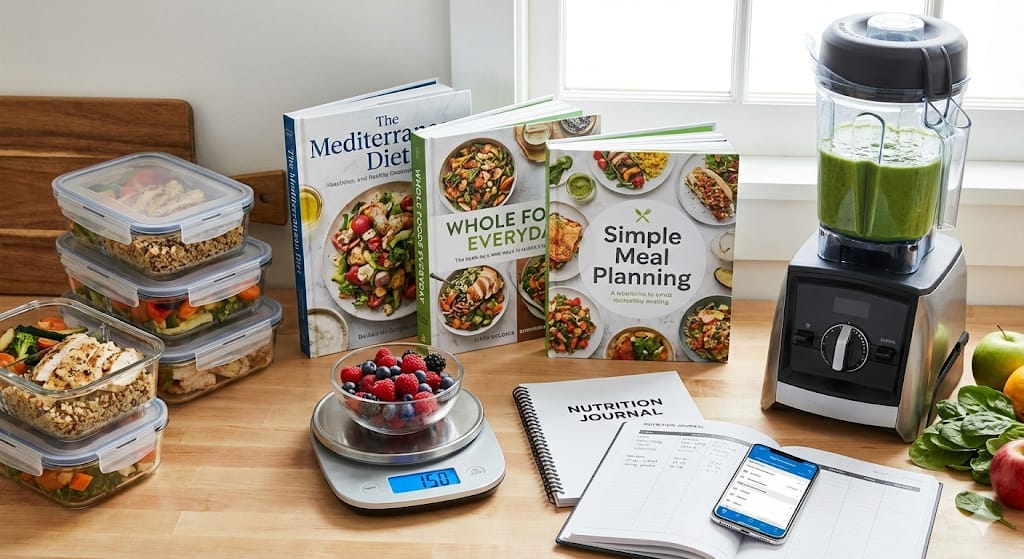
The plate method is the practical tool I actually use. Half the plate vegetables and fruit, a quarter lean protein, a quarter whole grains. No weighing, no tracking, just a visual proportion check that takes about two seconds at meal time and covers the nutritional bases without requiring expertise.
Meal prep in some form helps. Not elaborate Sunday cooking sessions but small decisions: keeping hard-boiled eggs in the fridge, having cut vegetables ready to reach for, cooking a larger portion of rice or grains than I need for one meal. Reducing the friction between good intentions and actual eating is where most of the work happens.
Get Enough Quality Sleep Each Night
Sleep is the habit most people sacrifice first when life gets demanding and the one that costs the most when consistently shortchanged. I know this intellectually, and I have still made the mistake of treating it as negotiable during busy periods, always to the same result: a week of slightly impaired everything.
The science is settled on the basics. Adults need seven to nine hours. Sleep deprivation compounds quickly, and the deficit does not clear with one good night. The physical effects, immune function, hormonal regulationand tissueee repair are significant. The cognitive effects, concentration, decision making, and emotional regulation, are immediate and measurable.
What has made the most practical difference to my sleep quality is not any single product or technique. It is the consistency of timing. Going to bed and waking up at approximately the same time daily, including weekends, stabilises your circadian rhythm in a way that makes falling asleep easier and waking up less effortful. Your body stops having to guess what time it is.
The other change that helped was treating the hour before bed as genuinely winding down rather than just stopping. Dimmer light, no screens where possible or night mode where screens are unavoidable, something calm to read rather than something stimulating. My bedside setup, a warm lamp, a diffuser with lavender, whatever I am currently reading, exists specifically to signal to my brain that the day is over. It sounds small. Over time, it becomes reliable.

Practice Mindfulness and Reduce Stress
Mindfulness is the habit that took me longest to take seriously because the way it is usually presented, apps and breathing exercises and the word practice used with a gravity that felt slightly performative, did not match how I actually experience it.
What I have come to understand is that mindfulness is less about meditation and more about attention. The capacity to be present in what you are doing rather than running a parallel commentary about everything else you should be doing instead. That capacity is genuinely trainable, le and the returns are real: reduced anxiety, better focus, and a quieter relationship with stress.
For me, the practical version looks like this: journaling for ten to fifteen minutes most mornings, which serves as a clearing mechanism for whatever my brain has been circling. Deliberate single-tasking during focused work blocks rather than the fractured attention of having eight tabs open. Noticing when I have been mentally somewhere else for twenty minutes and returning without drama.
The formal meditation version, sitting quietly with attention on the breath, also genuinely works for the people who will actually do it. Apps like Headspace and Calm provide enough structure for beginners that the entry barrier is low. Five minutes a day is enough to start building the skill. Consistency matters more than duration.
The broader self-care principle applies to her, too. Pursuing things you genuinely enjoy, spending time outdoors, limiting passive screen consumption, scheduling space in your week that is not optimised for anything, these are not luxuries. They are the maintenance that makes everything else sustainable.
Conclusion
None of these habits requires a dramatic change of character or a complete restructuring of your days. That is precisely the point.
Pick one. The one that feels most immediately relevant or most achievable given where you are right now. Build it until it feels automatic. Then add another.
The goal is not a perfect wellness routine. It is a sustainable one that fits your actual life rather than an idealised version of it. Health built incrementally and maintained quietly over the years is worth considerably more than intense effort that burns out before it has time to compound.
Start small. Stay consistent. Trust the process more than the timeline.


You May Also Like
Bullet Journaling: A Beginner’s Guide to Organizing Your Life

Summer Body Goals: Keeping It Real With Yourself